Part II
Governmental Powers
- 1. Constitutional History: From Paris To Lisbon
- 2. Constitutional Nature: A Federation Of States
- 3. Governmental Structure: Union Institutions I
- 4. Governmental Structure: Union Institutions II
- 5. European Law I: Nature—Direct Effect
- 6. European Law II: Nature—Primacy/Pre-emption
- 7. Legislative Powers: Competence and Procedures
- 8. External Powers: Competence and Procedures
- 9. Executive Powers: Competence and Procedures
- 10. Judicial Powers I: (Centralized) European Procedures
- 11. Judicial Powers II: (Decentralized) National Procedures
- 12. Limiting Powers: EU Fundamental Rights
- 13. Free Movement: Goods I—Negative Integration
- 14. Free Movement: Goods II—Positive Integration
- 15. Free Movement: Persons—Workers and Beyond
- 16. Free Movement: Services and Capital
- 17. EU Competition Law: Private Undertakings
- 18. EU Internal Policies: An Overview
- 19. EU External Policies: An Overview
- 20. Epilogue: Brexit and the Union: Past, Present, Future
- 21. Appendix: How to Study European Law
- 22. Extra chapter: Competition Law II: State Interferences
Introduction
When compared to the legislative and executive branches, the judiciary looks like a poor relation. For the classic civil law tradition reduces courts to ‘the mouth that pronounces the words of the law’, and even the common law tradition finds that ‘[w]hoever attentively considers the different departments of power must perceive, that in a government in which they are separated from each other, the judiciary, from the nature of its functions, will always be the least dangerous to the political rights of the constitution’. In the eyes of both traditions, the judiciary is thus ‘the least dangerous branch’.
This traditional view originates in the eighteenth century. It reduces the judiciary to its adjudicatory function, that is: the power to decide disputes between private parties. Yet this position was to change dramatically in the nineteenth and twentieth centuries. Courts not only succeeded in imposing their control over the executive branch; some States even allowed for the constitutional review of legislation. These judicial ‘victories’ over the executive and legislative branch were inspired by the idea that all public power should be subject to the ‘rule of law’; and this idea would, in some legal orders, include the sanctioning power of the judiciary to order a State to make good damage caused by a public ‘wrong’.
A modern definition of the judicial function therefore needs to treat three core powers, which – in descending order – are: the power to annul legislative or executive acts, the power to remedy public wrongs and the power to adjudicate legal disputes between parties.
The following chapters explores these three judicial prerogatives within the Union legal order. Importantly: the judicial function is here ‘split’ between the Court of Justice of the European Union and the national courts. For the Union legal order decided, early on, to recruit national courts in the exercise of some judicial functions – and has thereby turned them into decentralised ‘European’ courts. This judicial federalism has indeed been a cornerstone of the Union and will be discussed in Chapter 11.
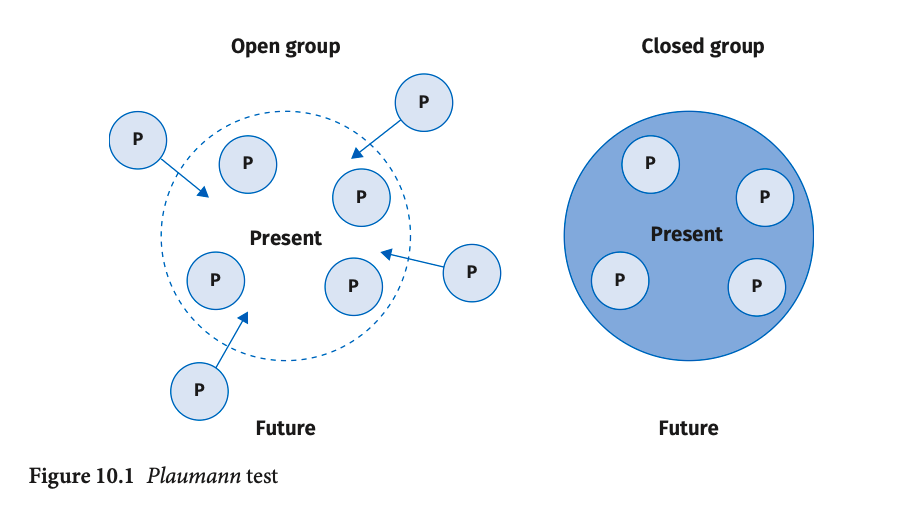
This chapter, however, will concentrate on the ‘centralised’ powers of the Court of Justice of the European Union (see Figure 10.1). Section 1 starts with an analysis of its annulment power. The power of judicial review is the founding pillar of a Union ‘based on the rule of law’. Section 2 moves to the remedial power of the European Court, and the question when the Union legislative or executive branches will be liable to pay damages for an illegal action. Finally, sections 3 and 4 investigate the Court’s power to adjudicate disputes between parties. In addition to a number of direct actions (direct actions start directly in the European Court), the EU Treaties here envisage an indirect action starting in the national courts: the preliminary reference procedure. This procedure is the judicial cornerstone of the Union’s cooperative federalism. For it combines the central interpretation of Union law by the Court of Justice with the decentralised application of European law by the national courts.
It goes without saying that this chapter cannot discuss all judicial competences of the European Court. An overview of the various judicial powers and procedures in the TFEU can nevertheless be found in Table 10.1. Importantly, the EU Treaties here acknowledge two general jurisdictional limitations: Articles 275 and 276 TFEU. The former declares that the European Court will generally ‘not have jurisdiction with respect to the provisions relating to the common foreign and security policy nor with respect to acts adopted on the basis of those provisions’. By contrast, the latter article decrees that the European Court ‘shall have no jurisdiction to review the validity or proportionality of operations carried out by the police or other law-enforcement services of a Member State or the exercise of the responsibilities incumbent upon Member States with regard to the maintenance of law and order and the safeguarding of internal security’. These two ‘holes’ in the judicial competences of the Court are deeply regrettable, for they effectively replace the ‘rule of law’ with the rule of the executive.


Cases
Legislation
No legislation available for this chapter.
Figures


Extra Materials
Useful Videos
Useful websites
Curia – The Treaty of Lisbon and the Court of Justice of the European Union
European Commission – European Commission at work: Infringement procedure
European Commission – European Commission at work: Annual Reports
European Commission – Legal Enforcement: The infringements procedure
EUR-Lex – The reference for a preliminary ruling
Further Reading
Books
A. Albors-Llorens, Private Parties in European Community Law: Challenging Community Measures (Clarendon Press, 1996)
S. Andersen, The Enforcement of EU Law (Oxford University Press, 2012)
A. Biondi and M. Farley, The Right to Damages in European Law (Kluwer, 2009)
M. Broberg and N. Fenger, Preliminary References to the European Court of Justice (Oxford University Press, 2014)
M. Cremona (ed), Compliance and the Enforcement of EU Law and Values Ensuring Member States’ Compliance (Oxford University Press, 2017)
A. Jakab and D. Kochenov (eds), The Enforcement of EU Law (Oxford University Press, 2012)
K. Lenaerts, I. Maselis and K. Gutman, EU Procedural Law (Oxford University Press, 2014)
L. Prete, Infringement Proceedings in EU Law (Kluwer, 2016)
A. Ward, Judicial Review and the Rights of Private Parties in EU Law (Oxford University Press, 2007)
Articles
A. Albors-Llorens, ‘Remedies against the EU Institutions after Lisbon: An Era of Opportunity’ (2012) 71 Cambridge Law Journal 507
S. Balthasar, ‘Locus Standi Rules for Challenges to Regulatory Acts by Private Applicants: The New Article 263(4) TFEU’ (2010) 35 EL Rev 542
M. Broberg and N. Fenger, ‘If You Love Somebody Set Them Free: On the Court of Justice’s Revision of the Acte Clair Doctrine’ (2022) 59 CML Rev. 711
A. Cuomo and P. Nicolaidis, ‘EU Liability and Judicial (Un)Predictability: An Appraisal of the Test for a Serious Breach of Law under Article 340(2) TFEU’ (2024) EL Rev. 615
K. Gutman, ‘The Evolution of the Action for Damages against the European Union and its Place in the System of Judicial Protection’ (2011) 48 CML Rev 695
L. Prete and B. Smulders, ‘The Coming of Age of Infringement Proceedings’ (2010) 47 CML Rev 9
H. Rasmussen, ‘The European Court’s Acte Clair Strategy in CILFIT’ (1984) 10 EL Rev 242 R. Schütze and T. Tridimas, Oxford Principles of European Union Law, Vol. I: The European Union Legal Order (Oxford University Press, 2018), chs. 27–32
R. Schwensfeier, ‘The TWD Principle Post-Lisbon’ (2012) 37 EL Rev 156
A. Turmo, ‘A Dialogue of Unequals—The European Court of Justice Reasserts National Courts’ Obligations under Article 267(3) TFEU’ (2019) EuConst 340
M. Vogt, ‘Indirect Judicial Protection in EC Law: The Case of the Plea of Illegality’ (2006) 31 EL Rev 364
N. Wahl and L. Prete, ‘The Gatekeepers of Article 267 TFEU: On Jurisdiction and Admissibility of References for Preliminary Rulings’ (2018) 55 CML Rev. 511
P. Wennerås, ‘Sanctions against Member States under Article 260 TFEU: Alive, but not Kicking?’ (2012) 49 CML Rev 145
How to Find (and Read) the EU Treaties
The EU Treaties constitute the primary law of the Union. The formula the ‘EU Treaties’ or simply ‘the Treaties’ commonly refers to two Treaties: the Treaty on European Union (TEU) and the Treaty on the Functioning of the European Union (TFEU).
The ‘Treaties’ are the result of a long ‘chain novel’ of consecutive treaties (see Table 20.1). They started out from three ‘Founding Treaties’ that created the European Coal and Steel Community (1951), the European Atomic Energy Community (1957) and the European (Economic) Community (1957). A myriad of subsequent ‘Amendment Treaties’ and ‘Accession Treaties’ gradually changed the textual basis of the three Communities significantly; and this first treaty base would be complemented by a second treaty base in 1992, when the Maastricht Treaty created the (old) European Union.
To simplify the – very complex – textual foundations of the old European Union and European Communities Treaties, the Member States tried to create a single treaty in the early 2000s. The 2004 Constitutional Treaty was indeed intended to repeal all previous treaties; and it was to merge the European Union with the European Communities. Yet the attempt to ‘recreate’ one Union, with one legal personality, on the basis of one treaty failed; and the Member States thereafter resorted to yet another ‘Amendment Treaty’: the 2007 Reform Treaty – also called the Lisbon Treaty.
Despite its modest name, the Lisbon Treaty constitutes a radical new ‘chapter’ in the Union’s constitutional chain novel. For while it formally builds on the original ‘Founding Treaties’, it has nonetheless ‘merged’ the old ‘Community’ legal order with the old ‘Union’ legal order into a new ‘Union’ legal order.

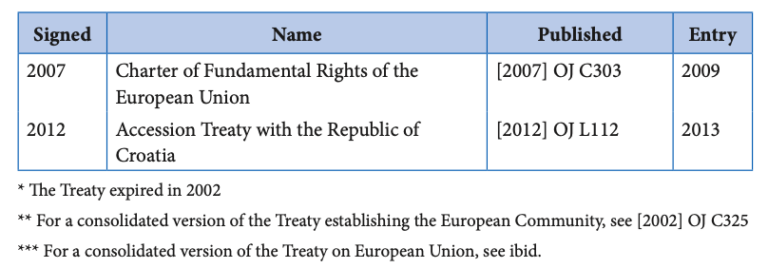

Nevertheless, unlike the 2004 Constitutional Treaty, the 2007 Lisbon Treaty has not created a single treaty base for the European Union. Instead, it recognises the existence of two (main) treaties: the Treaty on European Union and the Treaty on the Functioning of the European Union. The division into two EU Treaties thereby follows a functional criterion: the Treaty on European Union (TEU) contains the general provisions defining the Union, while the Treaty on the Functioning of the European Union (TFEU) contains the specific provisions with regard to the Union institutions and policies. One of the new features of the post-Lisbon era is the possibility of minor treaty amendments instigated by European Council Decisions.

In addition to ‘Amendment Treaties’ there are now also ‘Amendment Decisions’ adopted by the European Council (see Table 21.4). The EU Treaties can today be found on the European Union’s

EUR-Lex website: http://eur-lex.europa.eu/collection/eu-law/treaties.html, but there are also a number of solid paper copies such as Blackstone’s EU Treaties & Legislation or my own EU Treaties and Legislation collection. What is the structure of today’s EU Treaties? The structure of the TEU and TFEU is shown in Table 20.4. The (longer) TFEU is divided into ‘Parts’ – ‘Titles’ – ‘Chapters’ – ‘Sections’ –‘Articles’, while the (shorter) TEU only starts with a division into ‘Titles’. The EU Treaties are joined by numerous Protocols and the ‘Charter of Fundamental Rights’. According to Article 51 TEU, Protocols to the Treaties ‘shall form an integral part thereof’; and the best way to make sense of them is to see them as legally binding ‘footnotes’ to a particular article or section of the Treaties.
By contrast, the Charter is ‘external’ to the Treaties; yet it also has ‘the same legal value as the Treaties’.
How to Find (and Read) EU Secondary Law
The Union publishes all of its acts in the Official Journal of the European Union. Paper versions can be found in every library that houses a ‘European Documentation Centre’, but electronic versions are also openly available on the Union’s EUR-Lex website: http://eur-lex.europa.eu/oj/direct-access.html. The Union distinguishes between two Official Journal series: the L-series and the C-series. The former contains all legally binding acts adopted by the Union (including its international agreements), while the latter publishes all other information and notices. Originally, only the paper version of the Official Journal was ‘authentic’; but since 1 July 2013, electronic versions of the Official Journal (e-OJ) are equally authentic and therefore endowed with formal legal force.
Union secondary law will first mention the instrument in which it is adopted. It will typically have the form of a ‘Regulation’, a ‘Directive’ or a ‘Decision’. This will be followed by two figures. In the past, where the Union act was a regulation, the figure was: number/year; while for directives and decisions this was inversed: year/number. However, since 2015, this has changed and all main Union instruments are now arranged by year/number.treaty base would be complemented by a second treaty base in 1992, when the Maastricht Treaty created the (old) European Union.
Where the year and number are known for a given EU act, the easiest way to find it is to use the Union’s EU-lex search engine: http://eur-lex.europa.eu/homepage.html. Importantly, there may be two or more acts for a given number combination, especially where a ‘legislative’ act has been followed by a non-legislative act. For two types of non-legislative acts – namely: ‘delegated’ and ‘implementing’ acts – the EU Treaties require that they contain the word ‘delegated’ or ‘implementing’ in their title. This is to indicate – at first glance – that these executive acts have been adopted according to a particular decision-making procedure. States thereafter resorted to yet another ‘Amendment Treaty’: the 2007 Reform Treaty – also called the Lisbon Treaty.
What is the structure of a piece of Union legislation? After its ‘Title’ there follows a brief summary of the decision-making procedure that led to the adoption of the act – including a reference to the legal competence on which it was based. Thereafter comes the ‘Preamble’, which sets out the reasons for which the Union act has been adopted. The content of the act is subsequently set out in various ‘articles’, which may be grouped into ‘Sections’ and ‘Chapters’. For very technical Union legislation, there may also be an Annex – which, like a ‘Schedule’ in a UK statute, adds detailed provisions ‘outside’ the core content of the act. To illustrate this legislative structure, let us take a closer look at the Services Directive as it would be published in the Official Journal.

How to Find (and Read) EU Court Judgments
All EU cases are identified by a number/year figure. Cases before the Court of Justice are preceded by a C-, while cases decided before the General Court are preceded by a T-( for the French ‘Tribunal’).7 The Civil Service Tribunal prefixed its cases with an F-( for the French ‘Fonction publique’). Following this unique figure come the names of the parties to the case. A full case name would for example be: Case C-144/ 04, Werner Mangold v. Rüdiger Helm. However, since no one can remember all the numbers or all the parties, EU cases often get simply abbreviated by the main party; in our case Mangold.
In the past, judgments of all EU Courts were published in paper form in the purple-bound European Court Reports (ECR). Cases decided by the Court of Justice were published in the ECR-I series; cases decided by the General Court were published in the ECR-II series, while cases decided by the Civil Service Tribunal were published in the ECR-SC series. However, as of 2012, the entire Court of Justice of the European Union decided to go ‘paperless’ and it now publishes its judgments only electronically.8 The two principal websites here are the Court’s own curia website (http://curia.europa.eu/jcms/jcms/j_6), and the Union’s general EUR-Lex website (http://eur-lex.europa.eu/homepage.html). For the purposes of this book, the easiest way is however to go to www.schutze.eu, which contains all the judgments mentioned in the main text – including the ‘Lisbon’ version of all classic EU Court judgments.
Once upon a time, judgments issued by the European Court were – to paraphrase Hobbes –‘nasty, brutish and short’. Their shortness was partly due to a structural division the Court made between the ‘Issues of Fact and of Law’ (or later: ‘Report for the Hearing’), which set out the facts, procedure and the arguments of the parties, on the one hand, and the ‘Grounds of Judgment’ on the other. Only the latter constituted the judgment sensu stricto and was often very short indeed. For the Court originally followed the ‘French’ ideal of trying to put the entire judgment into a single ‘sentence’! A judgment like Van Gend en Loos contains about 2,000 words – not more than an undergraduate essay.

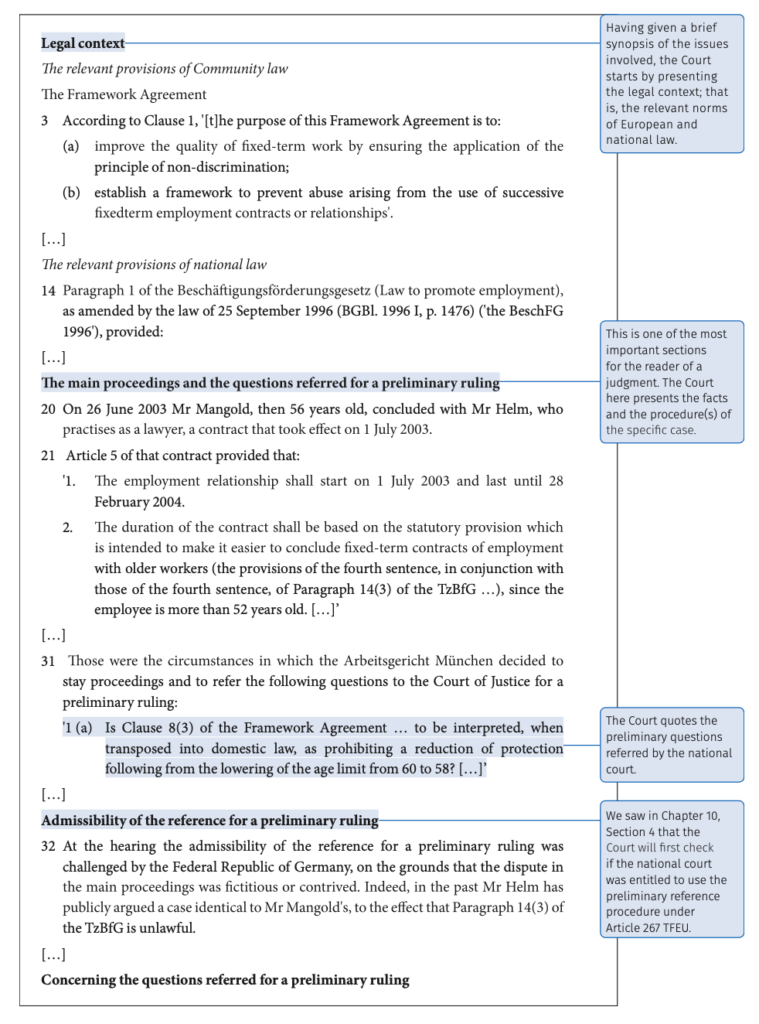

This world of short judgments is – sadly or not – gone. A typical judgment issued today will, on average, be four to five times as long as Van Gend. (And in the worst-case scenario, a judgment, especially in the area of EU competition law, may be as long as 100,000 words – a book of about 300 pages!) This new comprehensiveness is perhaps the product of a more refined textualist methodology, but it also results from a change in the organisation and style of judgments. Modern judgments have come to integrate much of the facts and the parties’ arguments into the main body of a ‘single’ judgment, and this has especially made many direct actions much longer and much more repetitive! The structure of a modern ECJ judgment given under the preliminary reference procedure may be studied by looking at Figure 20.2.
How to Find EU Academic Resources
The literature with regard to European Union law has exploded in the last 30 years. Today, there exists a forest of European law journals and generalist textbooks. Moreover, since the mid 1990s ‘European’ law has increasingly developed specialised branches that are sometimes even taught separately at university (as is the case at my own university). The three main branches here are: European constitutional law, European internal market law and European competition law. The first was explored in Parts I and II, while the second branch (and elements of the third branch) were covered in Part III. In addition to these three ‘bigger’ branches, the last two decades have also seen the emergence of many ‘smaller’ branches, such as European external relations law, European labour law and European environmental law. And there now also exist specialised LLM courses on EU consumer law and EU tax law.
The list of journals (Table 21.5) is by no means comprehensive. It is meant to point the interested reader to a first gateway for an in-depth study of a particular part of European Union law. My selection focuses primarily on English-language academic sources. But it goes without saying that European Union law is a ‘European’ subject with journals and textbooks in every language of the Union.
